
What an Earth-Covered Magazine Delivers
Precast concrete earth-covered magazines for ammunition and explosives storage.
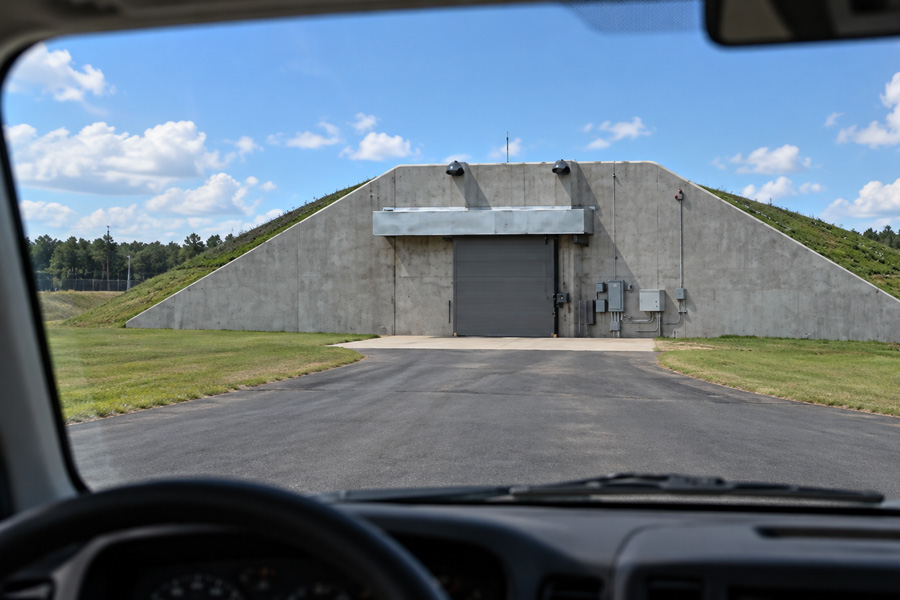
A Carolina Precast earth-covered magazine (ECM) is a reinforced precast concrete storage structure covered on the top, sides, and rear with compacted earth, leaving only the headwall and door exposed. The concrete structure and the earth cover work together to protect stored ammunition and explosives from an explosion at a neighboring magazine, and to help prevent a chain reaction from one magazine to the next.
The Department of Defense recognizes two types of magazine for ammunition and explosives storage: earth-covered and aboveground. Earth-covered magazines are the type used where larger quantities must be stored safely at closer spacing. Ours are manufactured at our Siler City, North Carolina facility and engineered to DoD explosives safety and physical security criteria.
Core Capabilities
- Reinforced precast concrete structure, cast and cured under controlled plant conditions
- Designed to the explosives safety criteria of DESR 6055.09 and UFC 4-420-01
- Headwall with a blast-resistant door and provisions for DoD-specified locking hardware
- Earth cover on the top, sides, and rear, with a minimum of 2 feet over the structure
- Ventilation, lightning protection, and grounding integrated in the design
- Prepared for intrusion detection systems where the stored AA&E requires them
- Noncombustible concrete construction that will not rust or corrode

How an Earth-Covered Magazine Works
The Department of Defense classifies ammunition and explosives storage magazines as either earth-covered or aboveground. A magazine counts as earth-covered only when it carries at least 2 feet of earth cover. With less, it is treated as an aboveground magazine and sited accordingly.
Every ECM is built from the same basic components. What varies from one project to the next is the size of the magazine, the strength of its headwall, and the quantity of explosives the site plan allows it to hold.
Key Components
- Precast concrete body: the roof, side walls, and rear wall, reinforced to carry the earth cover and resist external blast pressure
- Headwall: the exposed front wall that carries the door and determines the magazine’s headwall designation
- Blast-resistant door with provisions for an internal locking device or a high-security padlock and hasp
- Retaining walls at the headwall that hold the earth cover in place
- Earth cover: compacted fill over the top, sides, and rear, graded to the slope the design specifies
- Ventilators, lightning protection, and grounding
Headwall Designations
DESR 6055.09 assigns each earth-covered magazine a designation based mainly on the strength of its headwall and door: 7-bar, 3-bar, or Undefined. That designation, together with the net explosive weight (NEW) stored, sets the quantity-distance (QD) separation the magazine needs from other magazines, roads, and occupied buildings.
Stronger designations allow magazines to sit closer together, which matters on installations where storage area is limited. Our engineering team works with your explosives safety office to match the magazine design to your site plan.

Where Earth-Covered Magazines Are Used
Earth-covered magazines serve military installations, ammunition depots, and DoD contractor facilities that store ammunition and explosives in bulk. They are grouped in dedicated explosives storage areas, with separation distances set by the installation’s explosives safety site plan.
Because the concrete structure is manufactured in our plant while site preparation proceeds, a precast ECM adds storage capacity on a shorter schedule than a magazine cast in place. Once placed and covered, it provides a long, low-maintenance service life in any climate.
- Bulk ammunition and explosives storage at depots and installations
- New storage areas, or added capacity alongside existing magazines
- Replacement of aging magazines that no longer meet current criteria
- AA&E storage at DoD contractor facilities
Compliance and Standards
Earth-covered magazines are governed by DoD explosives safety and physical security standards, not generic construction benchmarks. Ours are designed against those standards from the start.
- Explosives safety standards of DESR 6055.09, Defense Explosives Safety Regulation (which replaced DoD 6055.09-M)
- Design criteria of UFC 4-420-01, Ammunition and Explosives Storage Magazines
- Physical security provisions of DoD Manual 5100.76, Physical Security of Sensitive Conventional Arms, Ammunition, and Explosives, including locking hardware and intrusion detection readiness
- Manufactured under a quality management system structured to meet PCI plant certification requirements
Why Precast Concrete
Many prefabricated magazines on the market are built from steel. Ours are precast concrete, the traditional material for earth-covered magazines, produced in a plant rather than cast in place.
Advantages of Precast Concrete
- Noncombustible: concrete does not burn, a critical property where explosives are stored
- Mass and reinforcement that absorb and distribute blast energy
- No rust or corrosion under earth cover or in wet climates
- Concrete continues to harden over the life of the structure
- Plant-controlled casting and curing for consistent strength and reinforcement placement
- Minimal maintenance once installed
For a broader comparison of the two materials across forced entry, fire, and blast performance, see Precast Concrete vs. Steel for Secure Vault Construction.
How We Deliver an Earth-Covered Magazine
Every earth-covered magazine follows a four-stage process, from first consultation to a magazine ready for service.
Engineering and Site Planning

Plant Manufacturing

Delivery and Placement

Verification and Handoff

Frequently Asked Questions
ECMs store ammunition and explosives (AA&E) in bulk, from small-arms ammunition to explosives and missile components. How much any one magazine may hold is set by its design and by the net explosive weight (NEW) allowed in the installation’s explosives safety site plan. For weapons storage and unit-level ammunition, see Preassembled Armories.
Concrete is noncombustible, does not rust or corrode under earth cover, and continues to harden over its service life. Manufacturing in a plant gives consistent strength and reinforcement placement, with a shorter site schedule than a magazine cast in place. For more on how the two materials compare, see Precast Concrete vs. Steel for Secure Vault Construction.